Casorso Ranch / Land Stewardship
Our Philosophy: Active Management vs. Passive Neglect
Why doing nothing in a dry interior landscape isn’t conservation — it’s environmental damage.
The Green Fallacy
Overgrown doesn’t mean healthy.
There is a widespread belief that leaving nature alone is always best for the environment. In the dry interior valleys of the Okanagan, doing nothing is itself a form of environmental damage.
To an untrained eye, a dense stand of tightly packed trees looks lush and natural. In our region it is an ecosystem in distress. Historically this landscape was never a closed-canopy forest. It was a sunlit grassland–savanna, kept open by frequent, low-intensity ground fires that cleared young conifer seedlings while leaving large, thick-barked pines standing.
When those fire cycles stopped and nothing replaced them, thousands of small conifers invaded the range — a process foresters call forest ingrowth. What looks like a healthy forest is, ecologically, a thirsty and dangerous weed patch.
In dry interior ecosystems an unmanaged stand can carry well over 1,000 trees per hectare — many times the density of its natural, fire-maintained state. True grassland–savannas thrive on open space, not closed canopy.
One hectare, two futures
The same ground, managed and unmanaged.
Both panels below represent the same 100 m × 100 m of Okanagan hillside. The only difference is whether the natural thinning cycle was allowed to continue.
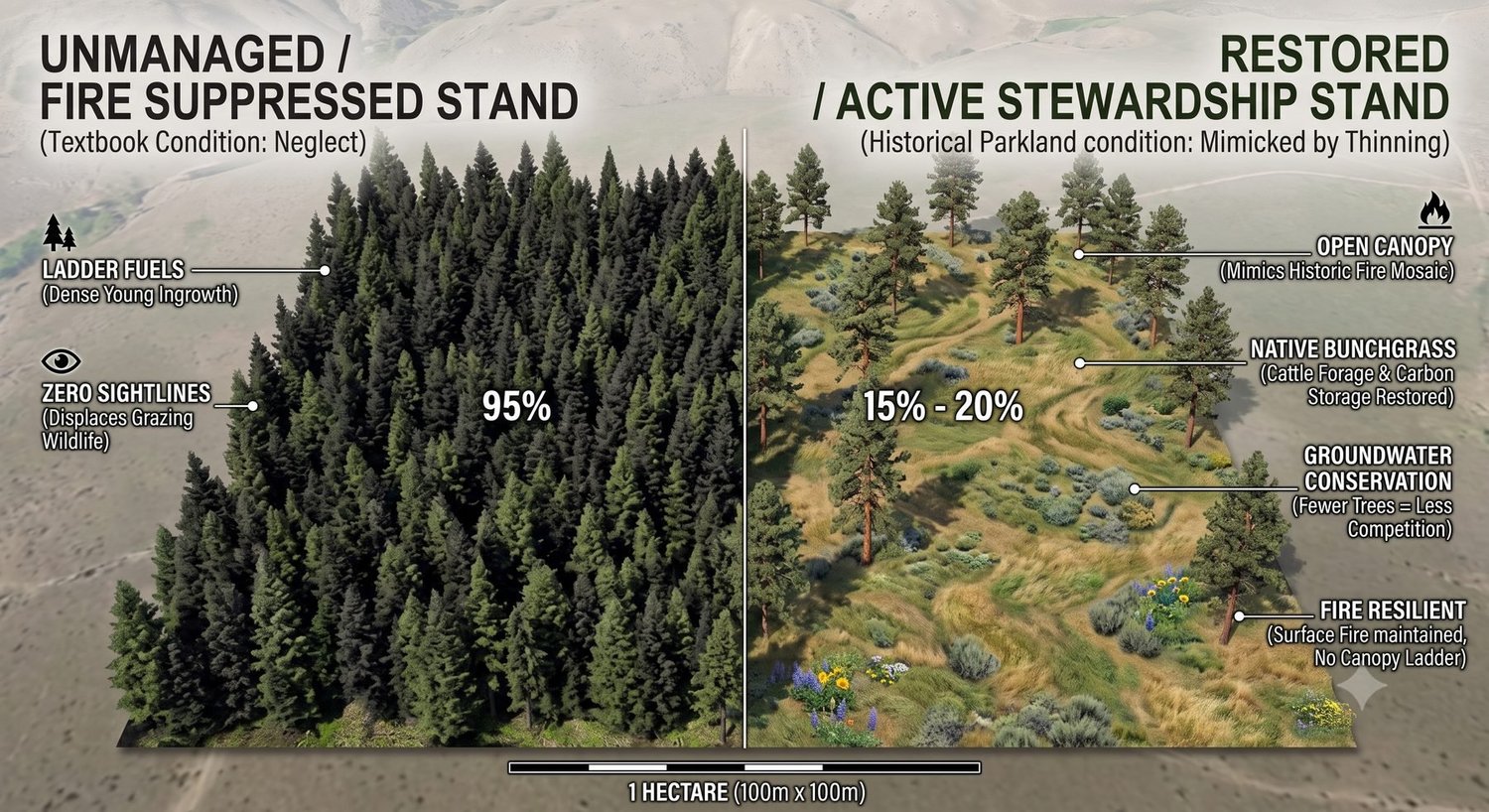
The neglected stand
Textbook condition: passive neglect- Ladder fuelsDense young ingrowth carries surface fire straight into the crowns.
- Zero sightlinesGrazing wildlife and predator detection are displaced.
- Bare, shaded floorUnder 10% grass cover — dry needle litter and brush.
- Water competitionHundreds of stems per hectare competing for the same soil moisture.
The working parkland
Historic condition, mimicked by thinning- Open canopyCrowns separated — mimics the historic fire mosaic.
- Native bunchgrassCattle forage and deep-root carbon storage restored.
- Groundwater conservedFewer stems means far less competition for soil moisture.
- Fire resilientFire stays on the surface — no ladder into the canopy.
The numbers
Three states of the same ecosystem.
Stems per acre (SPA) and trees per hectare (TPH) are the most objective way to measure how far a dry-interior stand has drifted from its natural condition. These figures apply to the dry Ponderosa pine and Interior Douglas-fir forests and savannas of the southern interior.
| Ecology state | Description | Trees / acre (SPA) | Trees / hectare (TPH) | Open ground cover |
|---|---|---|---|---|
| Historically correctPre-contact · pre-1850 | Maintained by frequent natural and Indigenous fires. Widely spaced, very large, ancient trees. Minimal underbrush. | 10–40 | 25–100 | Over 90% bunchgrass & sagebrush |
| CurrentUnmanaged fire suppression | Decades of fire exclusion. Extreme infilling by young, weak conifers — forest ingrowth — forming tight thickets. High fuel load. | 200–1,000+ | 500–2,500+ | Under 10% bunchgrass. Dense needle litter & brush |
| RestoredOur conservation goal | Achieved by removing small-diameter ingrowth and reintroducing low-intensity fire. Mimics natural openness while retaining younger cohorts. | 30–70 | 75–175 | About 75% bunchgrass. Widely spaced clusters |
← Scroll the table sideways to see all columns.
The solution
What we are doing at Casorso Ranch.
We refuse to let passive neglect degrade the land in our care. Because we cannot let wildfire run freely through a valley full of homes, mechanical thinning is the only practical way to reproduce the cycle that kept this landscape healthy for thousands of years.
Selective thinning of ingrowth
We systematically remove dense stands of small, choked saplings while protecting the mature, thick-barked trees that evolved to survive fire.
Opening the canopy
Restoring light to the forest floor brings back deep-rooted native bunchgrasses that store carbon in the soil and provide rich forage.
Creating natural fireguards
Removing ladder fuels means a fire that does pass through stays low to the ground, where it can be managed without wiping out the ecosystem.
Integrating livestock & ecology
Targeted grazing alongside brush management mimics the natural disturbance patterns that kept this region thriving for centuries.
The evidence
This isn’t just our opinion.
Forest ingrowth and grassland encroachment are well documented in the peer-reviewed literature, and they are the basis for the fuel-management and prescribed-burn programs run by the BC Wildfire Service, Parks Canada and local First Nations.
Fire once returned every 7 to 20 years. Tree-ring records from BC’s Ponderosa Pine and dry Interior Douglas-fir zones show site-mean fire intervals clustering around 8 to 16 years before frequent fire ceased between the 1920s and 1950s — near Oliver, 8 years; near Spences Bridge, 7 years; Trout Creek, 16 years.Gayton, D.V. 2013. Documenting fire history in a British Columbia ecological reserve. Journal of Ecosystems and Management 14(1).
Ladder fuels are the mechanism. The four established principles of fuel reduction — reduce surface fuels, increase height to live crown, decrease crown density, and retain large fire-resistant trees — are exactly what selective thinning accomplishes.Agee, J.K. & Skinner, C.N. 2005. Basic principles of forest fuel reduction treatments. Forest Ecology and Management 211(1–2): 83–96.
Conifers moved onto BC grasslands within living memory. Encroachment onto the Chilcotin grasslands began in the early 1930s, following a documented fire chronology of roughly 10-year intervals from 1759 to 1926 — after which the scarring fires simply stop.Strang, R.M. & Parminter, J.V. 1980. Conifer encroachment on the Chilcotin grasslands of British Columbia. The Forestry Chronicle 56(1): 13–17.
The density shift is order-of-magnitude. Benchmark reconstructions of dry ponderosa pine forest structure record pre-settlement densities in the tens of trees per hectare against modern fire-suppressed stands measuring in the hundreds to thousands — a ten- to thirty-fold increase in stem density.Covington, W.W. & Moore, M.M. 1994. Southwestern ponderosa forest structure: changes since Euro-American settlement. Journal of Forestry 92(1): 39–47.
Stewardship is not passive
Real conservation isn’t watching the land choke.
A healthy ecosystem in the dry interior takes work, vision and a willingness to be misunderstood. By thinning overgrown timber and pushing back forest encroachment, we aren’t altering nature — we are undoing a century of interrupted fire and giving the native grassland its life back.
At Casorso Ranch we manage for resilience, forage, wildlife and safety. Because real conservation isn’t watching the land choke — it’s helping it breathe.